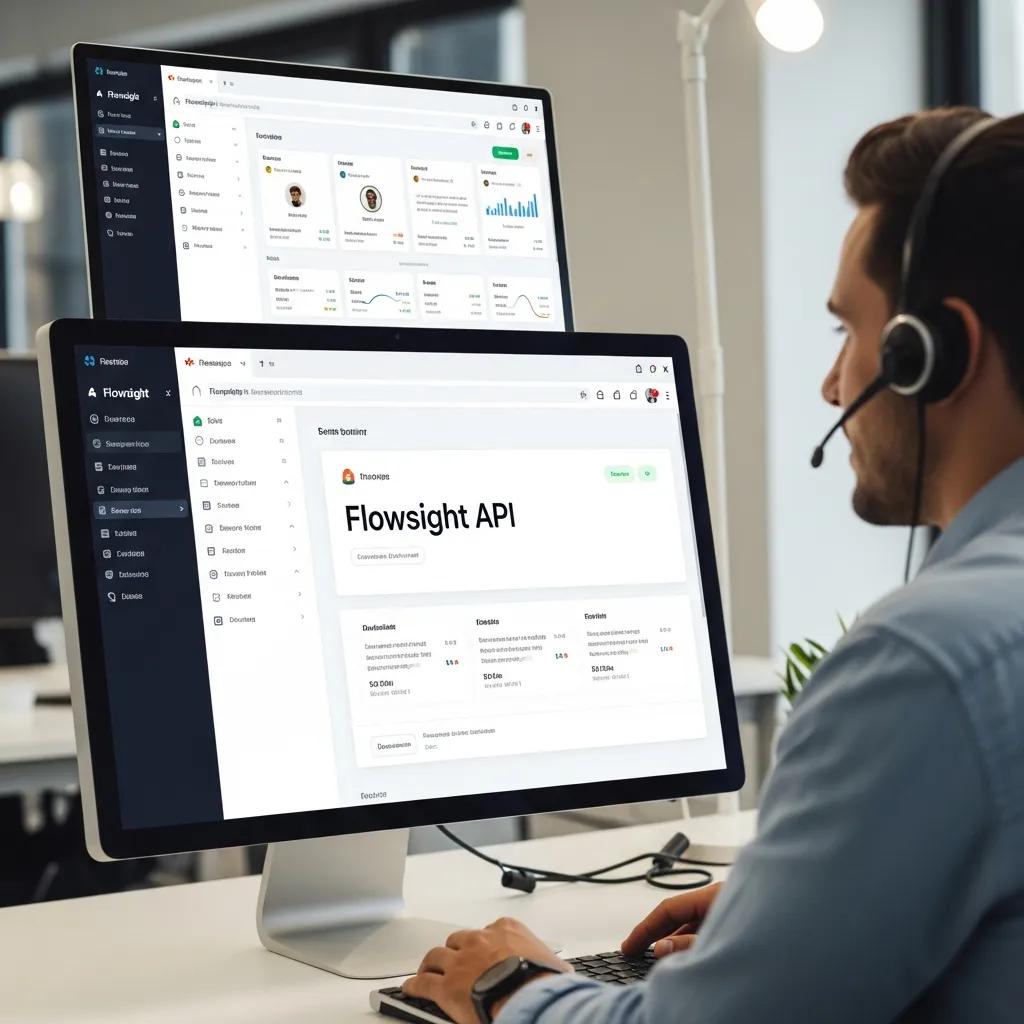

Flowsight API & Integrations: Comprehensive Guide to Voice Agent and CRM Automation
The Flowsight API is a powerful tool designed to enhance the capabilities of voice agents and streamline CRM automation. This comprehensive guide will delve into the functionalities of the Flowsight platform, its integration with CRM systems, and the benefits it offers to businesses. As organizations increasingly seek to improve customer engagement and operational efficiency, understanding how the Flowsight API can facilitate these goals is essential. This article will cover the overview of Flowsight, key functionalities of the voice agent, integration processes with CRM systems, and the overall benefits of using Flowsight. By the end, readers will have a clear understanding of how to leverage this technology for enhanced customer interactions.
Overview of Flowsight
Flowsight is an advanced platform that integrates voice agents with various communication channels, enabling businesses to automate customer interactions effectively. By utilizing AI technology, Flowsight enhances the customer service experience through natural language processing and real-time data analytics. This integration allows for seamless communication between voice agents and CRM systems, ensuring that customer inquiries are handled efficiently and accurately. The platform’s capabilities not only improve response times but also enhance the overall customer experience, making it a valuable asset for businesses looking to optimize their operations.
The broader impact of such AI-powered virtual agents on Customer Relationship Management and service automation is widely recognized as transformative.
AI Virtual Agents: Transforming CRM & Service Automation
This article examines the transformative impact of AI-powered virtual agents on Customer Relationship Management systems. It explores how these sophisticated software entities are fundamentally redefining customer interactions and service automation across industries. It details how virtual agents enhance omnichannel engagement, enable intelligent self-service, and deliver proactive assistance that anticipates customer needs. Beyond basic task automation, these systems manage complex processes, optimize service delivery through intelligent routing, and contribute to organizational learning through operational intelligence. The article analyzes implementation considerations including integration requirements, change management st
AI-Powered Virtual Agents in CRM: Revolutionizing Customer Interaction and Service Automation, GRS Chowhan, 2025
Key Functionalities of the Voice Agent

The voice agent within the Flowsight platform offers several key functionalities that enhance its effectiveness in customer interactions. These include:
- Natural Interaction Capabilities: The voice agent can understand and respond to customer inquiries in a conversational manner, making interactions feel more personal and engaging.
- Automated Responses: By utilizing predefined scripts and AI-driven responses, the voice agent can handle common customer queries without human intervention, freeing up staff for more complex issues.
- Real-Time Data Processing: The voice agent can access and process customer data in real-time, allowing for personalized interactions based on the customer’s history and preferences.
These functionalities collectively contribute to a more efficient customer service process, reducing wait times and improving satisfaction.
Further research highlights the critical role of advanced AI techniques like natural language processing and reinforcement learning in achieving sophisticated, human-like interactions in automated customer service.
NLP & RL for Advanced Customer Service Automation
This research paper explores the integration of natural language processing (NLP) and reinforcement learning (RL) algorithms to enhance customer service automation, addressing the demand for more sophisticated and human-like interactions in automated systems. The study begins by reviewing current customer service technologies and identifying limitations in handling complex queries and adapting to diverse customer needs. It then proposes a novel framework that combines NLP for understanding and generating natural language and RL for dynamically improving the system’s performance through feedback and experience. The framework is designed to improve both response accuracy and user satisfaction by learning from interactions in real time. An experimental setup is developed, implementing the proposed approach using a dataset of customer interactions from a leading service provider. The system’s performance is evaluated against traditional rule-based and machine learning models using
Enhancing customer service automation with natural language processing and reinforcement learning algorithms, 2020
Integration with CRM Systems

Integrating the Flowsight API with CRM systems is a straightforward process that enhances data management and customer relationship strategies. The integration allows for seamless data synchronization between the voice agent and the CRM, ensuring that all customer interactions are logged and accessible. This capability enables businesses to maintain a comprehensive view of customer interactions, which is crucial for effective follow-up and relationship building.
Seamless Integration Process
The integration process typically involves the following steps:
- API Configuration: Setting up the Flowsight API within the CRM system to enable data exchange.
- Data Mapping: Aligning data fields between the voice agent and the CRM to ensure accurate information transfer.
- Testing and Validation: Conducting tests to ensure that the integration functions correctly and that data is synchronized as expected.
Benefits of Integration
Integrating Flowsight with CRM systems offers several advantages:
- Improved Data Management: Centralized data storage allows for better tracking of customer interactions and preferences.
- Enhanced Customer Insights: Access to comprehensive customer data enables more informed decision-making and personalized service.
- Increased Efficiency: Automation of data entry and retrieval processes reduces manual workload and minimizes errors.
Indeed, the evolution of CRM systems towards intelligent, AI-assisted platforms is fundamentally reshaping how organizations manage sales, service, and support operations.
AI-Assisted CRM: Enhancing Sales, Service & Support
Customer Relationship Management (CRM) systems are evolving from rule-based workflow engines into intelligent, autonomous platforms powered by Artificial Intelligence (AI). AI-assisted CRM agents represent a transformative shift in how organizations manage sales, service, and support operations by enabling real-time decision-making, contextual automation, and personalized customer engagement at scale. These agents leverage machine learning, natural language processing (NLP), and predictive analytics to augment human agents rather than replace them, improving operational efficiency, customer satisfaction, and revenue outcomes.
AI-Assisted CRM Agents for Sales, Service, and
Support Operations, GK Sangam, 2026
Benefits of Using Flowsight
Utilizing the Flowsight API provides numerous benefits for businesses looking to enhance their customer engagement strategies. Some of the key advantages include:
- Enhanced Customer Experience: By automating responses and providing personalized interactions, businesses can significantly improve customer satisfaction.
- Cost-Effectiveness: Automating routine inquiries reduces the need for extensive customer service teams, leading to lower operational costs.
- Scalability: The Flowsight platform can easily scale to accommodate growing customer bases and increasing interaction volumes without compromising service quality.
Comparison of Benefits
To illustrate the various benefits of using Flowsight, the following table summarizes key advantages:
This comparison highlights how Flowsight can transform customer service operations, making it a strategic choice for businesses aiming to enhance their engagement efforts.
Conclusion
In summary, the Flowsight API offers a robust solution for integrating voice agents with CRM systems, providing businesses with the tools needed to improve customer interactions and operational efficiency. By leveraging the capabilities of Flowsight, organizations can enhance their customer service experience, reduce costs, and scale their operations effectively. As the demand for efficient customer engagement continues to grow, adopting technologies like Flowsight will be crucial for staying competitive in the market.
Leave a Reply